

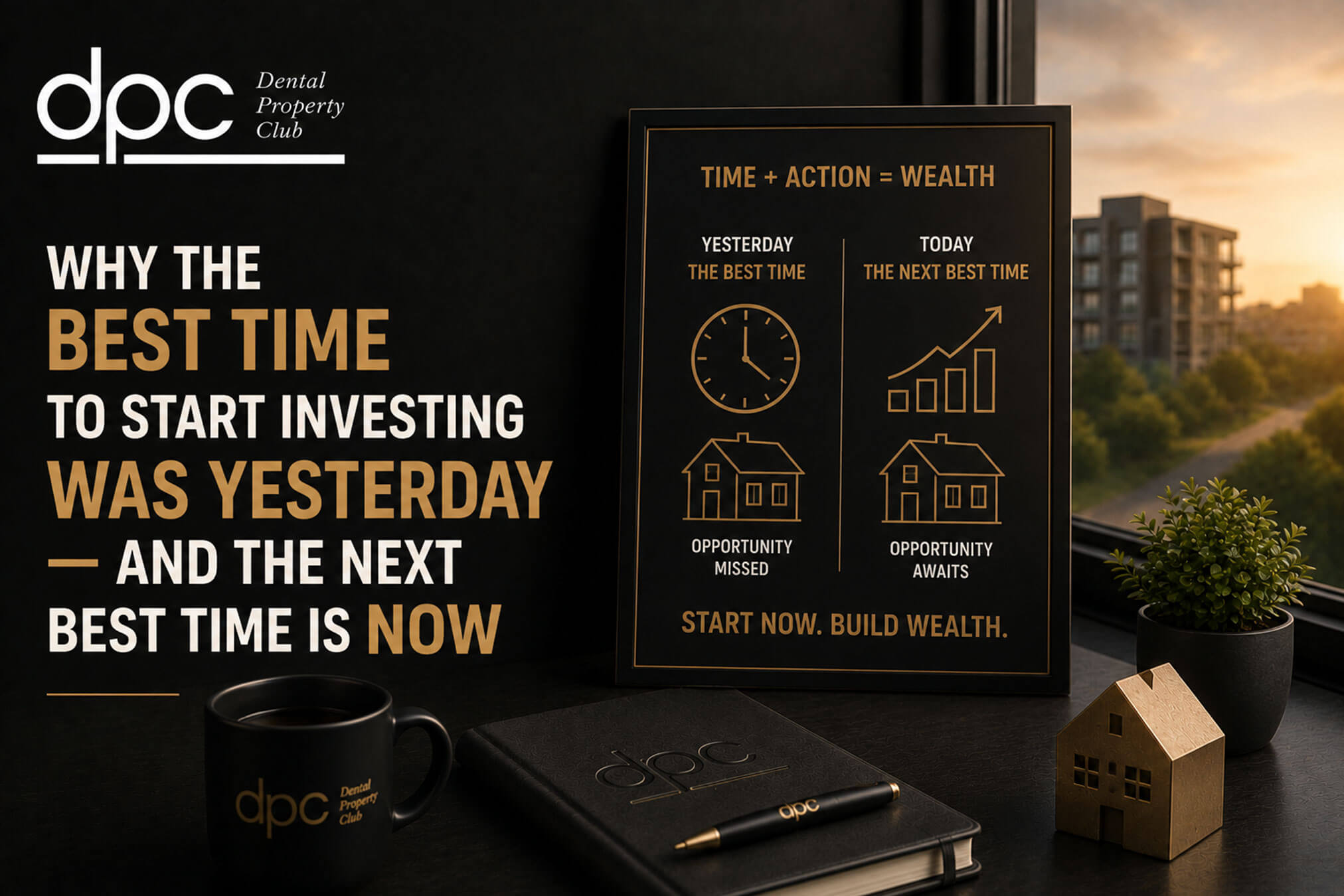
There is a question that comes up at almost every Dental Property Club workshop.
A dentist sits across the table, clearly intelligent, clearly aware that they need to do something different with their finances, and they say some version of:
“I’ve been meaning to do this for a while. I just haven’t found the right time.”
Sometimes it’s been two years of “meaning to”.
Sometimes it’s been five.
Occasionally, it’s a decade.
And underneath the polite framing is something that deserves an honest response:
There is no right time. There is only the cost of waiting — and it is higher than most people ever calculate.
The Number That Changes Everything
The most powerful concept in wealth building is compounding.
Most people have heard of it.
Almost nobody has sat with the actual numbers long enough for the full weight of it to land.
Here is a simple illustration.
Two dentists. Same income. Same starting capital.
• Dentist A invests £60,000 in a buy-to-let property at age 38.
• Dentist B waits — for the right time, for more certainty, for clarity — and does the same thing at
age 48.
Both hold for 20 years.
Assuming 3.5% annual capital growth and a modest net cash flow:
• Dentist A’s property has been compounding for 30 years by the time they are 68.
• Dentist B’s property has been compounding for 20 years.
The gap in final portfolio value between those two dentists — from a single decade of delay — is enormous. Not because Dentist B did anything wrong. But because time is the variable that compounding needs most, and it cannot be bought back.
This is not a metaphor.
It is arithmetic.
What "Waiting for the Right Time" Actually Means
Dentists are careful people by training and temperament.
They assess risk. They want adequate information before acting. They do not drill without first understanding the anatomy.
That caution is a clinical virtue.
In financial decision-making, it can quietly become a very expensive habit.
When dentists say “I’m waiting for the right time”, they often mean one of several things:
“I’m waiting until I have more information.”
There will always be more information. The market will always have more complexity to study. But no amount of research changes the fundamental fact that property held in a strong location over 10+ years has historically rewarded patient, properly structured investors.
“I’m waiting until my finances are cleaner.”
The finances rarely get cleaner on their own. Lifestyle tends to expand with income. Obligations grow. The “right moment” retreats as fast as income advances.
“I’m waiting for the market to be more favourable.”
The dentists who waited through the rate rises of 2022–2023 hoping for a perfect moment are watching rates fall in 2026 — but now worried about competing buyers as sentiment returns. There is always a reason to wait. There is never a perfect market.
“I’m just not quite ready.”
This is perhaps the most honest answer — and the most important one to examine.
Because often, “not ready” does not mean unprepared. It means uncomfortable with change. And that discomfort, if left unexamined, is not protecting you. It is costing you.
The Real Cost of One Year's Delay
Let us make this concrete rather than theoretical.
Assume:
• You are 42 years old.
• You buy a £180,000 property today with a £45,000 deposit.
• The property grows at 3.5% per year (conservative UK residential assumption).
• You hold it to age 65 — 23 years.
After 23 years at 3.5% growth:
£180,000 × (1.035)23 ≈ £389,000
Capital gain: approximately £209,000.
Now delay by just one year.
Same property, same assumptions, 22 years:
£180,000 × (1.035)22 ≈ £376,000
Capital gain: approximately £196,000.
One year’s delay: roughly £13,000 in capital growth alone — before rental income is even counted.
Across a decade of delay, that figure is not additive.
It is compounding in reverse — working against you with exactly the same force that would otherwise be working for you.
Why 2026 Is a Legitimate Window
Beyond the eternal truth of compounding, there are specific reasons why 2026 is a genuine opportunity — and not just a line used to create urgency.
Interest rates are falling.
The Bank of England base rate is forecast to reach 3.5% by late 2026, easing from peaks that cooled the market over the previous two years. Mortgage finance is becoming more accessible and more affordable for professional investors.
Rental demand remains structurally high.
Build-to-Rent occupancy rates across the UK are averaging approximately 97%. Demand for well-managed rental properties in major cities is not a trend or a cycle. It is a structural feature of a country that cannot build homes fast enough to meet population needs.
Some landlords are leaving.
The complexity of the post-Renters’ Rights Act environment is causing less committed, less professional landlords to exit. Their stock is entering the market. The buyers who understand what they are doing are picking up well-located assets in a market with less speculative competition than in 2021 or 2022.
Capital values are beginning to recover.
After the correction of 2022–2024, UK property capital markets are showing early and sustained improvement. Investors who enter at the beginning of a recovery cycle rather than at its peak are buying into future capital growth, not chasing it after it has already happened.
For a dentist with borrowing power, an established income, and the right framework, these conditions add up to a clear signal:
The window is open. Acting now beats acting later.
The Psychological Trap of Perpetual Preparation
There is a particular pattern worth naming, because it is extremely common among intelligent professionals.
It is the trap of perpetual preparation.
You read extensively about property investment.
You attend a workshop.
You listen to podcasts.
You discuss it with colleagues.
You monitor the market.
You feel like you are “doing something”.
But none of it produces an asset.
None of it generates rental income.
None of it begins the compounding clock.
The trap is insidious because preparation feels productive. It carries none of the discomfort of action. It involves no risk, no decision, no commitment. It can continue indefinitely without ever producing the outcome it was supposedly preparing for.
The antidote is not recklessness.
It is recognising that enough information to make a sound first decision is available right now — and that waiting for certainty, in a domain where certainty does not exist, is its own form of decision-making.
What Starting Now Actually Requires
To be direct: beginning your property investment journey does not require:
• Perfect financial conditions.
• A deep understanding of every regulatory nuance.
• Experience that can only be accumulated by doing the thing you are postponing.
• A guarantee of outcome.
It requires:
Not: Is my pension adequate?
• A clear deposit pot — or a plan to build one.
• A basic understanding of yield, cash flow, and finance structure.
• Access to the right advisors and framework.
• A decision to treat this seriously rather than as a long-term “maybe”.
Most dentists who engage with the Dental Property Club are not lacking in raw capacity.
They are lacking in structured permission to begin.
The Future Self Question
Here is a question worth sitting with seriously.
Imagine yourself at 60.
You have had a good clinical career. The income has been strong. But you have been fully dependent on that income throughout — there was no portfolio, no passive income, no asset base beyond a home.
Now ask:
What would you tell your current self to do differently?
Almost universally, the answer is some version of:
Start earlier. Be bolder. Stop waiting for certainty that never came.
The person who benefits from what you do today is not your present self, who finds change uncomfortable.
It is your future self, who will live with the consequences of today’s decisions for decades.
That person deserves better than another year of watching time — and compounding — pass.
Dr Harry Singh is the founder of the Dental Property Club (dentalpropertyclub.co.uk).

