

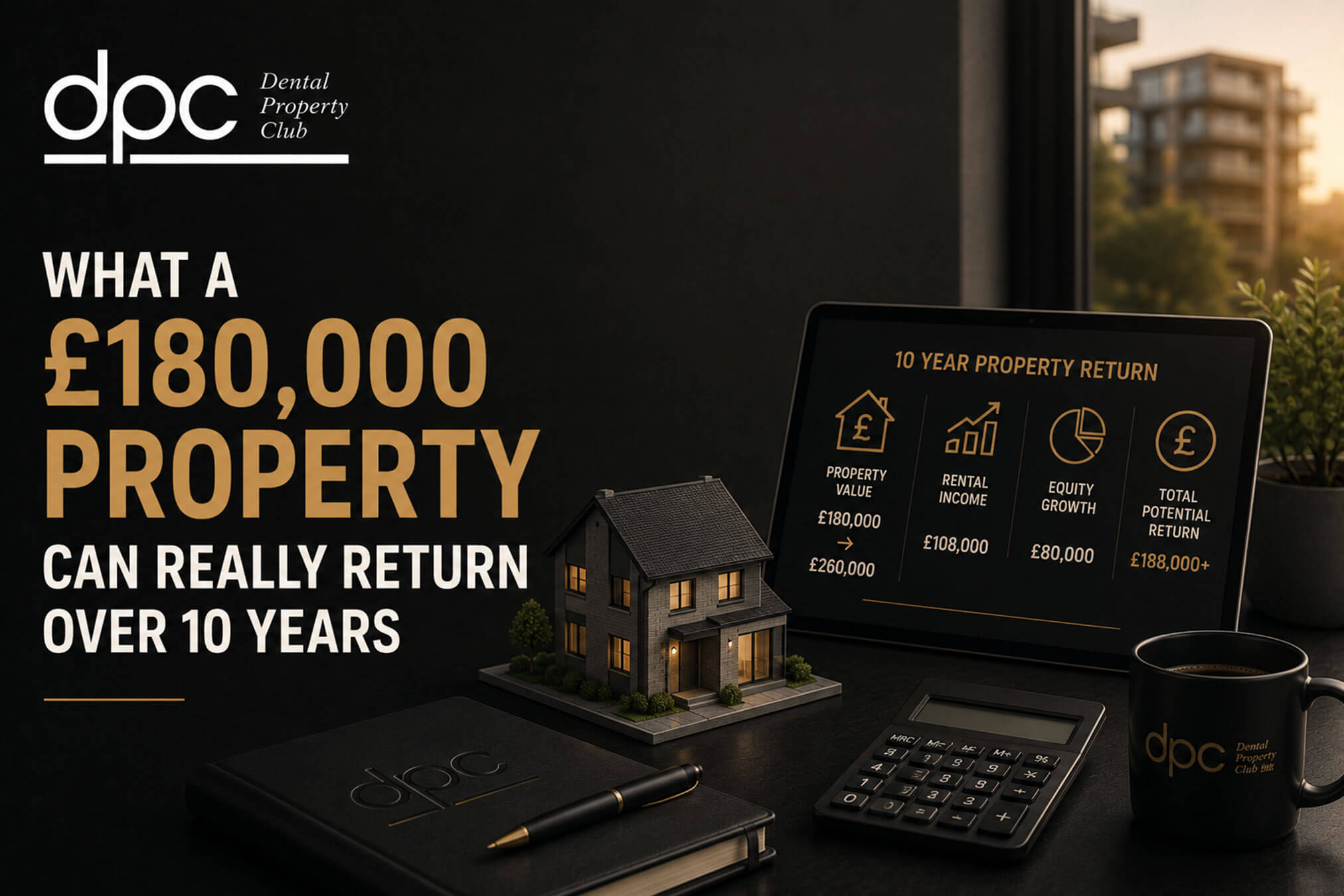
Dentists often ask a simple, sensible question:
“If I buy a typical £180,000 buy-to-let, what does it actually do for me over 10 years?”
They are not looking for hype. They are looking for numbers.
So let’s answer it properly — with realistic assumptions, plain-English maths, and a clear understanding of what a single well-chosen property can really achieve when held for a decade.
The Property: A Realistic 2026 Example
Let’s take a straightforward scenario based on 2026 UK market norms.
- Purchase price: £180,000
- Location: a strong Northern or Midlands city with solid tenant demand
- Gross rent: £900 per month (£10,800 per year)
- Gross yield: 6% (10,800 ÷ 180,000 × 100)
We will assume:
- 25% deposit: £45,000
- 75% loan-to-value (LTV) interest-only mortgage
- 5% mortgage interest rate (stress-tested, conservative)
- Letting agent manages the property
- Normal, sensible running costs
This is not a “unicorn” deal. It is very achievable in several 2026 markets.
1. The Cash Flow Over 12 Months
Gross rental income
- £900 per month = £10,800 per year
Typical annual costs
- Mortgage interest (approx): £6,750 (75% of £180,000 = £135,000 × 5%)
- Letting agent (10% + VAT approx): ~£1,300
- Insurance, safety certificates, basic maintenance provision: ~£750
Total costs (rough): £8,800
Net cash flow (before tax)
- £10,800 − £8,800 = £2,000 per year (~£165 per month)
In practice, you would also factor in:
- Voids (allow 1 month in 12)
- Occasional higher maintenance in some years
Even after these, a well-chosen 6% gross yield property can realistically produce £1,500–£2,000 per year in net cash flow before tax.
Is that life-changing on its own? No.
Is it proof of concept that the asset carries itself and contributes, instead of draining you? Yes.
And remember: the cash flow is only half the story.
2. The Capital Growth Over 10 Years
Nobody can forecast exact house prices.
But we can use conservative assumptions and established patterns.
UK property has delivered long-term average annual growth in the 3–5% range, with variation by area and cycle.
Let’s assume:
- 3.5% annual capital growth (neither aggressive nor pessimistic)
Using compound growth:
Future value = £180,000 × (1.035)¹⁰ ≈ £253,000
Capital gain = £253,000 − £180,000 = £73,000
So over 10 years, under a sensible growth assumption:
- Your £180,000 property becomes a £253,000 asset
- You have gained roughly £73,000 in equity from growth alone
That is without overpaying the mortgage or doing anything clever.
3. What Happened to Your £45,000 Deposit?
This is where the numbers get interesting.
You originally put in:
- £45,000 deposit
- Plus purchase costs (stamp duty, fees, etc.) — let’s say another £15,000
- Total cash in: ~£60,000
After 10 years:
- You have received around £15,000–£20,000 in net cash flow (assuming ~£1,500–£2,000 per year before personal tax).
- Your property has gained £73,000 in value (on our 3.5% assumption).
- You still owe roughly the same mortgage capital if you used interest-only.
So from ~£60,000 of initial cash, your position after a decade looks roughly like this:
- Asset value: £253,000
- Mortgage: £135,000 (interest-only)
- Equity: ~£118,000
- Cash flow received over 10 years: say £17,500 (midpoint)
Total economic benefit:
- Equity (£118,000) + cash flow (£17,500) ≈ £135,500
On ~£60,000 initial outlay.
That is more than 2× your money over 10 years, with the asset still in your name.
And remember: this is one property.
4. What If You Refinanced Instead of Just Holding?
At some point in that 10-year period, you might decide to remortgage.
Let’s say at Year 7 the property is worth ~£231,000 (the 3.5% growth curve). A 75% mortgage at that point is:
- 0.75 × 231,000 ≈ £173,250
If your original mortgage was £135,000, you could theoretically release:
- £173,250 − £135,000 = £38,250
That is almost another full deposit for a similar property — without selling anything.
This is the equity recycling that serious investors (and Dental Property Club members) use:
- Property 1 appreciates.
- You release some equity.
- You keep Property 1.
- You use the released capital as the deposit for Property 2.
- Now both assets are working for you.
Your original clinical income created the first deposit.
From that point on, the assets help fund further assets.
5. What Does This Mean for a Dentist Practically?
Take a mid-career dentist who:
- Uses clinical income over 24–30 months to build a £60,000 pot.
- Buys one £180,000, 6% yield property.
- Lets it run for a decade on interest-only, with professional management.
Ten years later, if they do nothing more than hold:
- They have an asset worth ~£253,000.
- They have roughly doubled their initial cash on equity + cash flow.
- They have something working while they sleep, independent of clinical work.
Now imagine they repeat this every 2–3 years.
Over a 10–15 year period, that is 3–5 properties:
- Each appreciating.
- Each generating net cash flow.
- Each potentially able to release equity for further growth.
That is how a handful of modest £180,000 properties become the backbone of real financial independence.
6. The Compounding That Dentists Rarely Experience Elsewhere
Most dentists are used to linear financial effort:
- You work.
- You are paid.
- The week resets.
Property is one of the few accessible tools that lets you experience compounding instead:
- Assets generate returns.
- Those returns help you acquire further assets.
- Time and market movement amplify what you have already done.
The £45,000 you put down on Day One is no longer a static pot of “saved money.”
It becomes:
- Equity growth
- Cash flow
- Remortgage capital
- Security
- Optionality
Over ten years, the original figure is almost unrecognisable compared with what it has grown into.
7. Reality Check: It Is Not Risk-Free or Effortless
It is important to be honest.
Over a decade of ownership, you will almost certainly experience:
- Maintenance spikes (boilers fail at inconvenient times)
- Occasional void periods
- Regulatory changes (like the Renters’ Rights Act)
- Interest rate fluctuations
- The need for a good letting agent and accountant
Property is not a magic machine.
It is a business asset that rewards being treated professionally.
But when approached with the right structure — yield, location, finance, and management — the numbers remain compelling, even after acknowledging the bumps.
8. The Real Question: What If You Don’t Buy It?
The counterfactual matters.
If you do not buy the £180,000 property:
- The £60,000 you might have invested often ends up dispersed across lifestyle, tax, ad-hoc savings, and inflation-exposed cash.
- Ten years from now, that money has rarely doubled itself while you sleep.
- You are still 100% reliant on whatever your clinical career can produce.
Property is not the only route to wealth.
But it is one of the few that:
- Uses your professional borrowing power.
- Creates its own income.
- Grows in value.
- Does not care whether you did 40 hours in surgery this week or none at all.
Dr Harry Singh is the founder of the Dental Property Club (dentalpropertyclub.co.uk).
- https://www.pace-properties.com/rental-yield-and-capital-growth/
- https://www.augustapp.com/blog/what-is-rental-yield
- https://www.theinternationalpropertypartners.com/articles/rental-yields-vs-capital-growth-understanding-the-difference-in-property-investment
- https://rosewood-property.co.uk/blog/understanding-rental-yield-and-capital-growth/32547
- https://www.cityrise.co.uk/rental-yields-or-capital-growth/
- https://www.regalestate.co.uk/news/what-does-rental-yield-and-capital-growth-mean/
- https://www.natwest.com/mortgages/buy-to-let/buy-to-let-mortgage-guide/why-rental-yield-is-so-important.html
- https://www.propertyinvestmentproject.co.uk/blog/calculating-which-property-is-the-wiser-investment/
- https://www.axa.co.uk/landlord-insurance/how-to-calculate-rental-yield/
- https://www.northwooduk.com/guides/buyers/yield-vs-capital-growth-whats-the-balance/

