
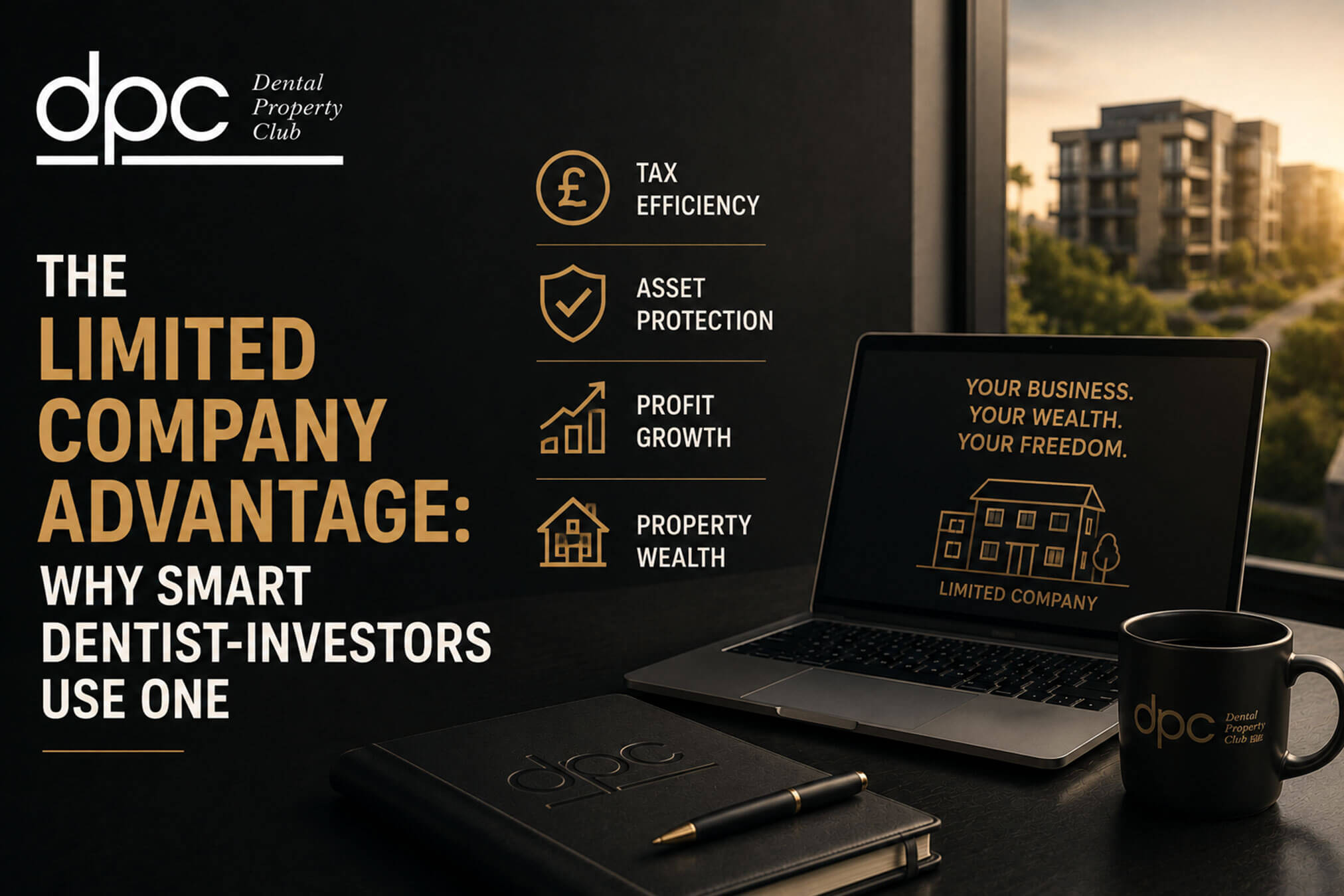
When dentists first look at property investing, one of the earliest questions is:
“Should I buy in my own name, or through a limited company?”
Ten years ago, the default answer for most small landlords was “in your own name”. Today, for many higher-earning professionals — especially dentists — the smarter answer is often the opposite.
This blog explains why so many serious dentist-investors now use a limited company for their property portfolio, and what that actually means in practice.
Why the Rules Changed for Individual Landlords
The turning point was Section 24 of the Finance Act — the tax change that started to restrict how much mortgage interest individual landlords could deduct from their rental income.
If you own property in your personal name:
- You can no longer deduct your full mortgage interest as an expense.
- Instead, you pay income tax on the gross rental profit and then receive a basic-rate (20%) tax credit on the interest.
- If you are a 40% or 45% taxpayer, this can dramatically reduce true net yield, because half or more of the tax relief has been taken away.
The effect is simple but brutal:
For many higher-rate landlords, the tax on their rental profits went up without rents changing.
As a result, holding property personally has become less attractive for exactly the group dentists sit in: high, stable earners who are often in the 40% tax band or affected by the loss of personal allowance.
That is why sophisticated investors began to look for a better structure.
How a Limited Company Changes the Tax Picture
A limited company (often a “Special Purpose Vehicle” or SPV) changes how your property profits are taxed.
Inside a company:
- Rental income is treated as business income.
- Mortgage interest is fully deductible as an expense before profit is calculated.
- The resulting profit is taxed at corporation tax rates, not your personal income tax rates.
- Profits can be retained in the company to fund further property purchases, without triggering personal tax immediately.
For a higher-rate dentist, this creates three key advantages:
1. Better treatment of mortgage interest
You get full relief, not just a 20% credit. This restores a big chunk of yield that Section 24 took away in personal ownership.
2. Control over when you pay personal tax
You can leave profits in the company to reinvest and only extract what you actually need, when you need it — planning dividends and salary more strategically.
3. Cleaner separation between your property business and personal finances
The company becomes a distinct wealth-building vehicle, with its own accounts, balance sheet, and growth trajectory.
For a dentist who wants to scale beyond one token buy-to-let, these advantages compound over time.
The SPV: A Simple Company Built for Property
In practice, most investors use a simple, focused company structure:
- A Special Purpose Vehicle (SPV) limited company
- With a narrow SIC code (e.g. “buying and selling of own real estate”)
- No trading activity outside property
Lenders like SPVs because:
- They are clean.
- They make underwriting simpler.
- The risk profile is clear and contained.
For you, an SPV means:
- A dedicated bank account for property income and expenses.
- Clear accounts that show the performance of your portfolio.
- Easier due diligence when remortgaging, refinancing, or doing joint ventures.
You and any co-investors (for example, a spouse) own the shares in the company. The company owns the properties.
Does a Company Help With Pension and Allowances?
For dentists, the interaction between property, income tax, and pension rules matters.
A few important points:
- The Annual Allowance for pensions is £60,000 for most people, but can taper down to £10,000 for high earners as adjusted income rises above £260,000.
- Property income held in a company does not count as pension contributions. It is a separate wealth pillar.
- However, using a company allows you to keep personal taxable income lower, because you can choose how much to draw out vs retain.
For some dentists, this can help:
- Avoid pushing adjusted income too far into the tapered allowance range.
- Smooth income year-on-year.
- Maintain some control over how much of their total economic activity actually hits their personal tax return.
It is not a magic pension solution. But it gives you planning flexibility that personal ownership does not.
Lender View: Can You Get Mortgages in a Company?
A common worry is that lenders “don’t like” company structures.
In 2026, the reality is the opposite:
- A large and growing number of buy-to-let lenders actively prefer SPV companies for professional investors.
- Products for company borrowers are widely available, including fixed-rate and interest-only options.
- Criteria are similar, though rates can be slightly higher and fees structured differently.
For a high-earning dentist, lenders typically assess:
- Your personal income (to ensure you are a credible borrower).
- The company’s purpose and structure.
- The rental cover on each deal (does the rent comfortably cover the mortgage at a stressed rate?).
Done properly, a company does not block access to finance.
It simply means you are playing the game as a professional, not as an accidental landlord.
It’s Not “Free Money”: The Downsides You Must Understand
A limited company is powerful, but it is not a free lunch.
You must also understand the trade-offs:
- Mortgage rates and fees can be slightly higher for companies than for individuals.
- You will have accountancy costs for annual accounts and corporation tax returns.
- When you take money out of the company (salary, dividends), you may pay personal tax on those drawings.
- If you already own properties personally and want to move them into a company, that is treated as a sale and repurchase — which can trigger Capital Gains Tax and Stamp Duty. That needs careful planning and bespoke advice.
For many dentists building a portfolio from scratch, starting inside a company avoids most of the transition pain. For those with existing properties, the decision requires proper modelling.
The point is not that companies are “better” in every case.
It is that for higher-rate, long-term, portfolio-minded dentist-investors, the advantages often outweigh the costs.
How It Fits With a Dental Career
The real test of any structure for you is not theoretical tax efficiency.
It is: does this make it easier to build a portfolio alongside a demanding clinical career?
A limited company helps because:
- It keeps your property numbers separate and visible.
- It allows you to build retained profits that are ring-fenced for reinvestment.
- It makes it easier to work with a joined-up “power team” — accountant, broker, solicitor — who can see the full picture and advise accordingly.
- It sends a clear message to yourself and others: “This is not a hobby. This is a parallel business designed to buy my freedom.”
That alignment between structure and intention matters more than most people realise.
When a Limited Company Makes the Most Sense
In practical terms, a limited company structure becomes increasingly attractive if:
- You are a higher-rate taxpayer (40% or 45%).
- You plan to build more than one or two properties.
- You are happy to reinvest profits for a period rather than extracting everything immediately.
- You want a clear, professional platform for potential joint ventures or family involvement in future.
If you only ever plan to own one small, unleveraged property, the argument is weaker.
If you intend to systematically turn clinical income into a multi-property asset base, the argument is strong.
The Bottom Line
A limited company structure does not replace the need for good deals, proper yield, risk management, or a clear portfolio strategy.
It simply ensures that:
- You are not punished excessively by Section 24.
- You have more control over when and how you pay tax.
- Your property activity looks and behaves like the professional wealth-building business it actually is.
For dentists, who already run one regulated, complex business in the form of a clinical career, it is often the cleanest way to run the second one — the property business that, if built well, can one day make the clinical work optional.
Dr Harry Singh is the founder of the Dental Property Club (dentalpropertyclub.co.uk).

