
Dentists are not short of intelligence.
You have navigated years of training, clinical exams, regulatory frameworks, and the day-to-day complexity of running or contributing to a practice.
And yet, when dentists first move into property, many make the same avoidable mistakes as everyone else — just with larger numbers.
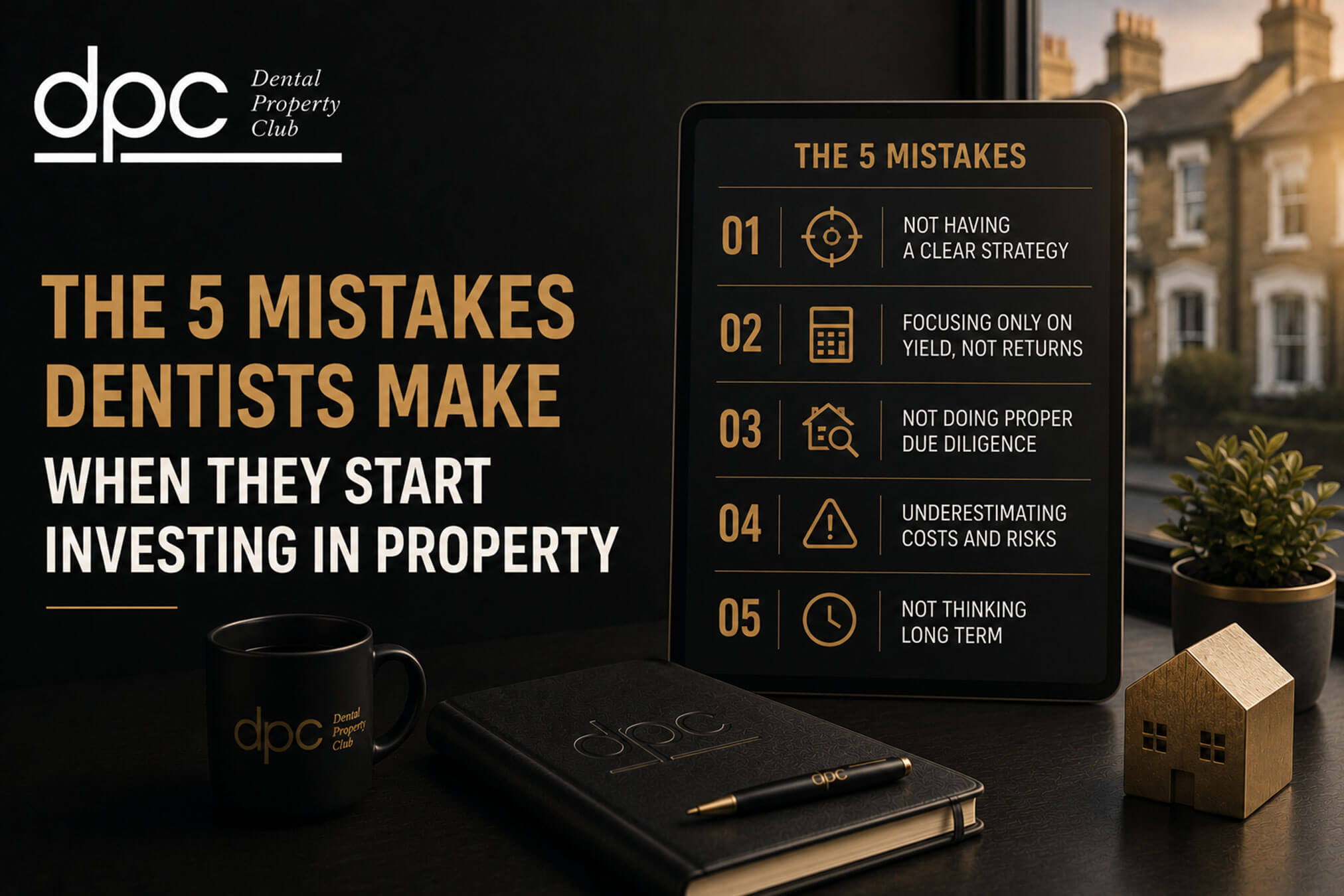
This blog outlines the five most common errors dentists make when they start investing in property, and how to avoid each of them.
Mistake 1: Buying With Emotion Instead of Numbers
Dentistry teaches you to care about detail, aesthetics, and how things feel.
That is a strength clinically.
In property, it can be dangerous.
New investors — including dentists — often:
- Fall in love with a property because they like it personally.
- Buy near where they live because it feels comfortable.
- Prioritise nice kitchens and bathrooms over rental demand and yield.
As several professional investor guides bluntly put it: “Buying based on emotion, not numbers, is the fastest route to regret.”
For an investment property, the right question is not:
“Would I like to live here?”
It is:
- Will it rent easily?
- Does the rent comfortably cover all costs?
- Is the yield strong enough, after everything, to justify owning it?
How to avoid it
- Decide your yield target up front (for example, 6%+ gross).
- Run the full numbers before you even view: rent comparables, purchase price, mortgage, costs.
- If the numbers don’t stack, do not try to talk yourself into the deal because it “feels right”.
In property, pretty loses to profitable every time.
Mistake 2: Underestimating Total Cash Needed
Many first-time investors think in terms of deposit only.
They hear “25% deposit” and assume that is roughly the total they will need.
In reality, your capital outlay includes:
- Deposit (often 25%)
- Stamp Duty Land Tax (including 3% additional property surcharge)
- Legal fees
- Survey / valuation
- Broker fees (sometimes)
- Initial refurbishment and furnishing
- Contingency and reserve funds
UK investor guides repeatedly highlight underestimating total cash as one of the most common beginner mistakes.
For a £180,000 property, it is entirely normal for your total cash requirement to be in the £60,000+ range once everything is included.
How to avoid it
- Build a full deal budget before committing: deposit + stamp duty + legals + refurb + furniture + 5–10% contingency.
- Assume costs will be slightly higher and slower than the perfect spreadsheet.
- If the deal only works with overly optimistic cost assumptions, it does not work.
This is not negativity. It is how you avoid being forced to inject extra cash halfway through, or getting stuck short.
Mistake 3: Ignoring Local Rental Demand
Some dentists who are used to making complex clinical decisions surprisingly buy property based on national headlines.
They see:
- “Manchester is booming”
- “Leeds is the new hotspot”
- “This city has great yields”
…and then buy in the wrong postcode, on the wrong street, in the wrong product type.
As multiple investor resources emphasise, national trends are irrelevant if local demand is poor.
What matters is:
- Who actually wants to rent this type of property in this specific area?
- How quickly do similar properties let?
- What are actual achievable rents, not asking prices?
How to avoid it
Before offering on a property:
- Check Rightmove and Zoopla for real rent comparables for similar properties.
- Speak with 2–3 letting agents in the area: ask what rents, how quickly, and to whom.
- Visit the area at different times of day if possible — or have a trusted local do so.
If you cannot clearly answer “who is my tenant and why will they choose this property?” — you are not ready to buy it.
Mistake 4: Overlooking Running Costs and Reserves
On paper, many deals look fine:
- Rent: £1,000 per month
- Mortgage: £600 per month
- “Profit”: £400 per month
In practice, this is often an illusion.
Beginners frequently forget:
- Letting agent fees (often 10–12% + VAT of rent)
- Maintenance (boilers, roofs, wear and tear)
- Compliance (safety checks, licences)
- Voids (weeks or months with no rent)
- Insurance and service charges where applicable
Experienced investors typically budget 1.5–2% of property value per year as an average long-term maintenance and reserves allowance.
Without that, one bad year can wipe out several years of apparent “profit”.
How to avoid it
- Build a net yield calculation, not just gross: Net yield = (annual rent − realistic annual costs) ÷ purchase price × 100.
- Maintain a reserve fund (e.g. 3–6 months of mortgage and basic costs per property).
- When you analyse a deal, ask: “Does this still make sense if I factor in realistic annual maintenance and one month void?”
If the answer is no, the deal is not truly cash-flow positive.
Mistake 5: Trying to DIY Everything Without a Power Team
Many dentists are familiar with being the person others rely on.
That strength — self-reliance and high standards — can morph into a weakness when you try to do everything yourself in property:
- Sourcing
- Analysing
- Negotiating
- Finance
- Legals
- Refurbishment
- Lettings
- Accounting
This “DIY everything” approach is one of the reasons new investors either burn out or move so slowly that compounding never really takes hold.
Property rewards those who build a team, not those who try to be the team.
How to avoid it
As early as possible, assemble your core power team:
- Specialist mortgage broker who understands professional and limited company lending.
- Solicitor experienced with buy-to-let and, ideally, investor transactions.
- Property-savvy accountant who understands Section 24, company structures, and long-term planning.
- Reliable letting agent in your target area.
- For heavier projects, a builder with a proven track record and investor references.
You do not have to become expert in everything.
Your job is to:
- Set clear strategy.
- Choose the right people.
- Make informed decisions based on their input.
That is how you run your property business with the same professionalism you bring to dentistry — without trying to be your own entire multidisciplinary team.
If you are a dentist serious about building a property portfolio and you want to avoid these mistakes from the start, the Dental Property Club was created for exactly that purpose.
Dr Harry Singh is the founder of the Dental Property Club (dentalpropertyclub.co.uk).
References
- https://www.10acre.co.uk/post/common-mistakes-uk-property-investment-2026
- https://www.youtube.com/watch?v=ECwcTCWTzPE
- https://northernpropertypartners.com/5-costly-mistakes-first-time-property-investors-make/
- https://www.dbrinvest.com/post/key-uk-property-investment-mistakes-to-avoid-in-2026-and-practical-ways-tocorrect-them
- https://www.10acre.co.uk/post/beginners-guide-uk-property-investment-2026
- https://propertyinvestorsnetwork.co.uk/property-investing-mistakes-2026/
- https://www.goldhouseaccounting.co.uk/property-investment-mistakes/
- https://urbanistarchitecture.co.uk/property-investment-mistakes/
- https://paragonproperty.co.uk/news/uk-property-investment-mistakes-and-how-to-avoid-them/
- https://www.youtube.com/watch?v=9FjVni4uXt8

