
Most dentists think of their clinical income as the end of the story.
You earn. You pay tax. You cover the mortgage, the practice costs, the school fees, the lifestyle. If there is anything left, you save it. Repeat next year. Hope it’s enough.
That is one way to live.
But there is another way to treat your clinical income: as a wealth engine, not an end point. As the fuel that builds a property portfolio which eventually pays you back — whether you are in surgery or not.
This blog explains exactly how to use the income you already generate to create assets that can outlast your clinical career.
Step 1: Change the Role of Your Income
The first shift is not financial. It is conceptual.
Your clinical income is not your “reward”. It is your capital generator.
Right now, most or all of it flows through to:
- Lifestyle
- Tax
- Debt servicing
- Occasional savings
What you are going to do instead is deliberately divert a percentage of that flow toward a separate goal:
Building income-producing assets.
Think of it like this:
- Clinical work = tool
- Salary / drawings = fuel
- Property portfolio = engine you are assembling
The more reliably you direct fuel into the engine, the more powerful it becomes — and the less your life depends on the tool.
Step 2: Decide Your “Wealth Allocation” Percentage
You do not need to overhaul your entire life overnight.
You do need a clear, non-negotiable percentage of income allocated to wealth-building.
For many dentists, a realistic starting target is:
- 10–20% of net clinical income ring-fenced for portfolio building
You can arrive at this number in two ways:
- Top-down: Decide “I will allocate 15% of my net income to wealth-building every month” and construct your lifestyle around what remains.
- Bottom-up: State your non-negotiable monthly lifestyle costs honestly, add tax and practice commitments, and instruct everything above that to flow into your investment pot.
The key is that this is a pre-commitment, not an afterthought.
You do not wait to see what is “spare”. You decide up front that a set amount is going to your future before you let the present consume it.
Step 3: Turn Surplus Into a Property Deposit
Once your wealth allocation is defined, your immediate goal is simple:
Build the deposit for your first investment property.
Let’s use round numbers.
Assume:
- You can allocate £2,000 per month from clinical income.
- You want to buy a £180,000 property.
- Deposit at 25% = £45,000.
- Acquisition costs (stamp duty, legal, fees, light refurb, buffer) = £15,000–£20,000.
Target pot: £60,000–£65,000
At £2,000 per month, that is roughly 30–32 months — but you can shorten this by:
- Adding any existing savings
- Redirecting bonus income (sale of assets, practice surplus, aesthetics income)
- Trimming lifestyle costs temporarily with a clear target in mind
Most dentists underestimate how quickly a deposit can be built when it becomes a named goal, not a vague idea.
Step 4: Let Borrowing Power Do the Heavy Lifting
Here is where being a dentist becomes a major advantage.
Banks and specialist lenders like lending to you.
- You have stable, documented income.
- You are in a secure profession.
- You often have a long track record with HMRC.
- You are unlikely to disappear overnight.
This is exactly what lenders look for.
When you combine:
- A realistic deposit
- A strong earning profile
- Clean credit
…you unlock the piece that makes property so powerful: leverage.
Leverage means:
- You do not need £180,000 to buy a £180,000 property.
- You need a deposit and the ability to service the mortgage.
- The bank provides the rest.
Your clinical income’s role here is specific:
- It helps build the deposit.
- It reassures lenders that you can handle the mortgage.
- Once the property is tenanted and cash-flow positive, the property’s own income starts servicing its debt.
Your income starts the process. The property sustains it.
Step 5: Insist on Positive Cash Flow From Day One
There is one non-negotiable rule if you are using clinical income to build a portfolio:
Your properties must not need feeding.
A property that needs topping up every month out of your practice income is not building freedom. It is adding strain.
The Dental Property Club framework sets a minimum target of 6% gross yield as a starting point. In 2026, that is achievable in many Northern and Midlands cities if you know where to look.
You want:
- Rent > all costs (mortgage, agent, insurance, maintenance, compliance allowance)
- A buffer for void periods
- A small surplus each month
Even £200–£300 per month net from Property 1 matters, because:
- It proves the model works.
- It can be saved toward Deposit 2.
- It means the property is not dependent on your clinical earnings.
Your income brought the asset into existence.
The asset must now learn to stand on its own feet.
Step 6: Use Clinical Income to Accelerate, Not Sustain
Once the first property is in place and cash-flowing, your clinical income’s role changes again.
It stops being the sole driver, and becomes an accelerator.
You now have three sources contributing to the next deposit:
- Ongoing clinical income allocation
- Rental surplus from the first property
- (In time) Equity release from capital growth and mortgage pay-down
What dentists often miss is that the second and third sources grow faster than the first.
Your clinical income is capped by time and tolerance.
Your assets are not.
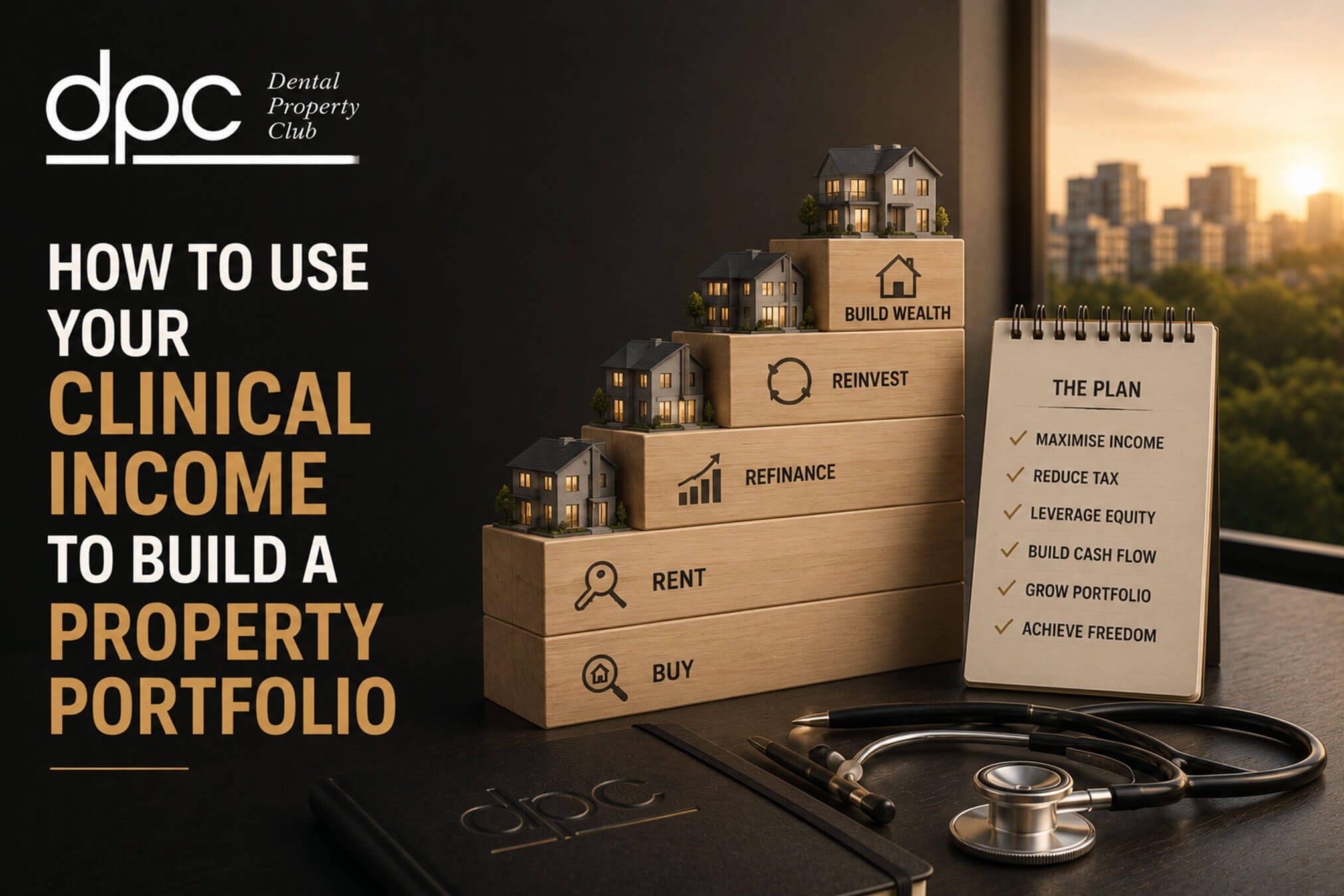
The DPC model is built around this progression — using clinical income heavily to get the first deal done, then proportionately less as the portfolio begins to compound.
Step 7: Protect the Engine (You) as You Build the Portfolio
There is an obvious but often overlooked truth:
- Your clinical income is the launch capital.
- If you lose it completely before the portfolio is in place, the plan is compromised.
This is why risk reduction and income protection matter alongside property.
Key protections to consider:
- Own-occupation income protection that pays if you cannot perform dentistry specifically, not just “any job”.
- Adequate emergency fund so a temporary clinical setback does not force you to sell assets.
- Appropriate life and critical illness cover aligned with your portfolio and family commitments.
The goal is not just to build assets.
It is to make sure you stay in the game long enough for the assets to do what they are designed to do.
Step 8: Treat the Portfolio Like a Parallel Business
This is where many dentists get it wrong.
They see property as:
- “Something on the side”
- “A passive thing I’ll sort later”
- “A savings alternative”
In reality, once you move beyond a single property, you are now running a second business — a property business — with its own:
- Cash flow
- Tax structure
- Systems
- Team
- Strategy
This is a good thing.
Because a second business that:
- Is not tied to your body
- Operates while you sleep
- Throws off cash and appreciates
…is exactly the sort of business a demanding clinical career needs alongside it.
But it does mean:
- You use professional letting agents, not WhatsApp and guesswork.
- You have a property accountant, not just a general tax return.
- You review performance annually, as you would with practice metrics.
Your clinical income built something worthy of professional attention. Give it that attention.
Step 9: Know What Success Actually Looks Like
Using clinical income to build a portfolio is not about owning “a few houses”.
It is about reaching a point where:
- Passive net income covers a meaningful portion of your living costs.
- Your ability to reduce or reshape clinical work is a choice, not a financial emergency.
- Your pension is a bonus, not the only plan.
For some dentists, success might be:
- 4–5 properties producing £2,000–£3,000 net per month.
For others:
- 8–10 properties plus practice income, setting up a very comfortable semi-retirement.
The number is less important than the principle:
Your clinical income has been converted into assets that outlive your career.
Step 10: Get a Framework, Not Just Information
The reason many dentists never turn income into assets is not lack of intelligence. It is lack of structure.
They:
- Read a few articles.
- Watch a YouTube video.
- Talk to a friend who “has a buy-to-let”.
- Then get overwhelmed and stay where they are.
The Dental Property Club exists to replace overwhelm with a proven sequence — from first deposit planning, to first acquisition, to portfolio growth, specifically for dentists.
You already have the income.
The missing piece is the system.
Dr Harry Singh is the founder of the Dental Property Club (dentalpropertyclub.co.uk).

