
Once dentists see what a single buy-to-let can do, the next question tends to be:
“Should I stick with simple single-lets, or look at HMOs for higher returns?”
It is a good question.
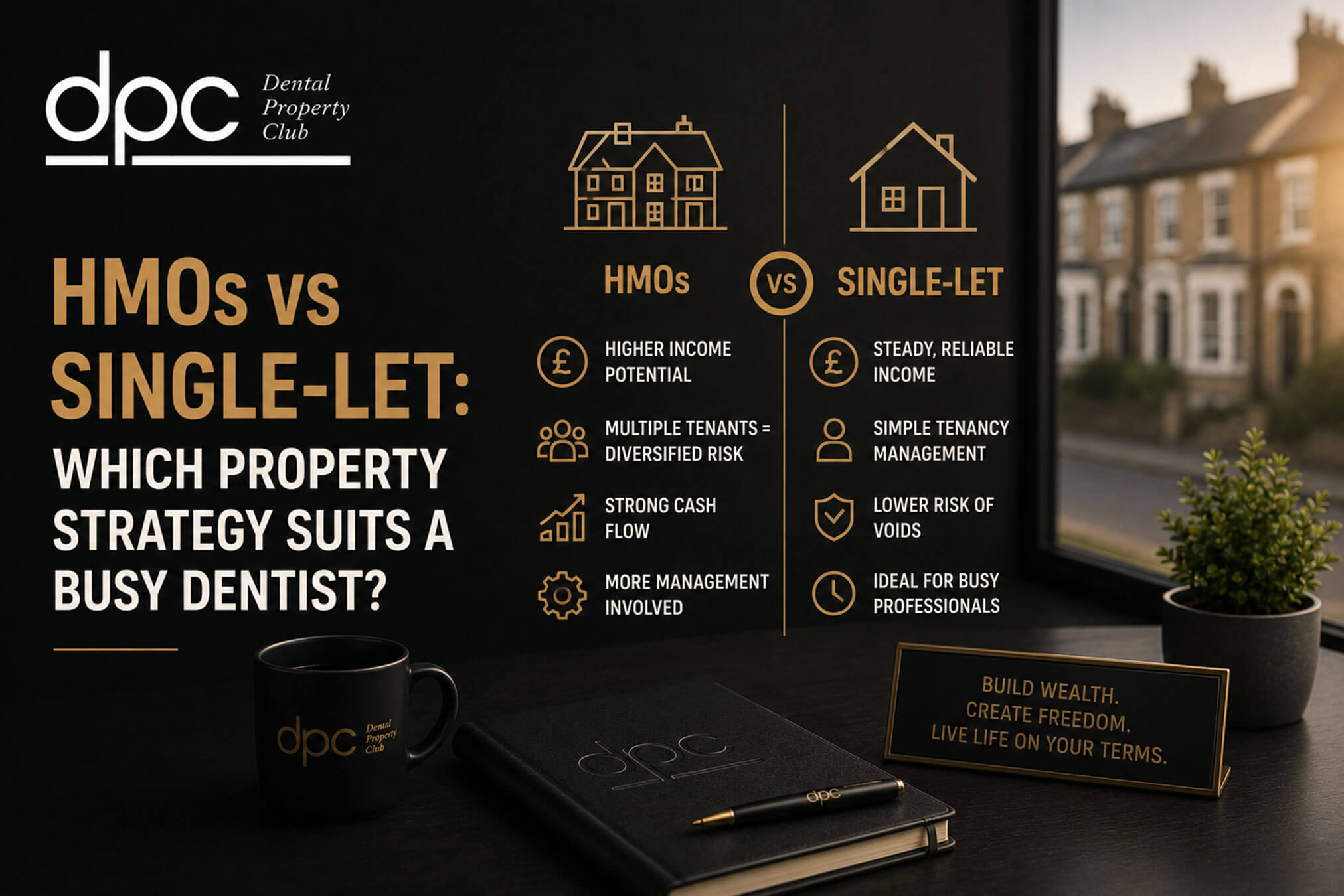
Because while both can be excellent tools for building financial freedom, they behave very differently in terms of:
- Yield
- Complexity
- Management
- Risk
- Fit with a demanding clinical career
This blog is a clear, practical comparison — so you can make an informed choice aligned with your personality, time, and goals.
What Is a Single-Let?
A single-let is the classic buy-to-let:
- One property
- One tenancy agreement
- One household (family, couple, or individual)
- One rent payment each month
Example:
- 3-bed terraced house, rented to a family on a 12-month AST (Assured Shorthold Tenancy)
- Rent: £900 per month
In 2026, a typical single-let in a decent UK city produces:
- Gross yields around 5–6% in many regions, depending on purchase price and rent levels.
Single-lets are simple, easy to understand, and exactly what most people picture when they think “landlord”.
What Is an HMO?
An HMO (House in Multiple Occupation) is different:
- One property
- Multiple unrelated tenants
- Each has their own bedroom
- They share common areas (kitchen, lounge, bathrooms)
- Tenants often have individual tenancy agreements
Example:
- 4-bed HMO rented by the room to young professionals
- Rent: £550 per room, per month = £2,200 gross monthly rent
HMOs are more complex — but they also usually produce significantly higher yields.
In 2026:
- Standard single-lets: average gross yields around 5–6%.
- Well-run HMOs in strong cities: 8–12%+, and in some Northern/Midlands locations up to 9–15%.
So at headline level:
- Single-let = simpler, lower yield
- HMO = more complex, higher yield
The rest of this blog is about what sits underneath that summary — and what it means for you as a busy dentist.
Yield: Income vs Effort
Single-lets
- Tenant pays one rent.
- Lower day-to-day management once a good tenant is in.
- Lower gross income, but also fewer moving parts.
HMOs
- 4, 5, 6 (or more) tenants all paying rent individually.
- Higher gross rent and yield.
- More “moving parts”: more people, more rooms, more wear and tear.
The crucial question is not:
“Which yields more on paper?”
It is:
“Which yields more per unit of hassle I’m willing to tolerate?”
If you are willing to:
- Handle more management (or pay for high-quality specialist HMO management)
- Navigate more regulation (licensing, fire safety, amenity standards)
- Accept more tenant turnover
…an HMO can make sense, because the extra yield can fund further growth faster.
If you want property to be as close to invisible in your week as possible, a good single-let may be more aligned.
Regulation and Compliance
This is where the gap between single-lets and HMOs becomes stark.
Single-lets:
You must still comply with:
- Gas and electrical safety
- EPC standards
- Deposit protection rules
- Right to Rent checks
- Landlord responsibilities under the Renters’ Rights framework
But in most cases, there is:
- No licence (unless in a selective licensing area)
- Simpler amenity requirements
- Less intense local authority scrutiny
HMOs:
Depending on size and local policy, you may face:
- Mandatory HMO licensing (5+ occupants forming 2 or more households)
- Additional / selective licensing schemes in some councils
- Strict minimum standards for:
o Room sizes
o Number of bathrooms and kitchen facilities
o Fire safety systems (linked alarms, fire doors, emergency lighting)
- More frequent inspections and compliance checks
Regulation is not a reason to avoid HMOs — but it is absolutely a reason to treat them as professional projects, not casual experiments.
For most dentists, this means:
- Using a specialist HMO letting/management agent
- Having a power team (planner, builder, HMO-savvy solicitor, accountant)
If that sounds exciting and “project-like” to you, HMOs may be a good fit.
If that sounds exhausting, single-lets will feel saner.
Tenant Profile and Turnover
Single-lets:
- Typical tenants: families, couples, long-term professionals.
- Average tenancy length: often 2–3 years or more in good properties.
- Lower churn = fewer check-ins, inspections, re-lets.
- Relationship can become stable and predictable.
HMOs:
- Typical tenants: students, young professionals, sharers.
- Higher churn: many move annually or every 6–18 months.
- Multiple move-ins and move-outs per year.
- Greater emphasis on constant marketing, referencing, room-level management.
Higher yield often comes with higher turnover.
If you or your agent are set up for that, it is fine.
But do not underestimate the emotional load of multiple tenant movements if the systems aren’t robust.
Voids and Risk Spread
One of the biggest advantages of HMOs is risk spread.
- In a single-let, if your tenant moves out, income drops to zero until you re-let.
- In an HMO, if one of five tenants leaves, you still receive 80% of your gross rent while you re-fill the room.
In that sense, HMOs can actually be more resilient in terms of income continuity, even if they require more management.
However, this only holds if:
- The property is in a genuinely strong HMO location.
- The product (rooms, spec, location) matches what the local market wants.
- You price sensibly and manage well.
A poor HMO in a weak area can be a headache.
A good HMO in a strong area can be an extremely reliable engine.
Renovation and Upfront Work
Single-let:
- Often lighter refurb between purchases.
- Cosmetic improvements, basic kitchen/bathroom upgrades.
- You can buy “ready-to-let” stock and get going quickly.
HMO:
- Much more likely to involve heavy refurb or conversion (e.g. turning a 3-bed house into a 5-bed HMO).
- Upfront capex is higher.
- Planning permission and building regs may be involved.
- Timelines are longer before income starts.
Again, this isn’t bad — but it moves HMOs into the category of active projects, not passive buys.
For a dentist with:
- High income
- Limited time
- Appetite for leveraged, project-based growth
…this can be attractive, especially if they work within a framework like the Dental Property Club and use JV structures and a trusted build team.
If you are already stretched clinically and emotionally, it might be smart to start with one or two single-lets before stepping up.
Which Strategy Fits a Busy Dentist Best?
There is no single right answer.
But you can use a simple self-assessment:
Single-let is likely better if you:
- Want low cognitive load from your investments.
- Prefer fewer moving parts and simpler compliance.
- Are happy with solid, steady returns rather than maximising every last percentage point of yield.
- Want your property investing to “sit in the background” of your life.
HMO is likely better if you:
- Have a strong agent and support team (or are happy to build one).
- Enjoy projects and see yourself as an active investor.
- Want to accelerate wealth-building with higher yields.
- Are comfortable with more complexity in exchange for more income.
Many Dental Property Club members eventually use a blend:
- Start with single-lets to learn the fundamentals and build confidence.
- Introduce HMOs later to increase portfolio income once the basics are solid.
The Dental Property Club View
From a Dental Property Club perspective, the decision is not “HMO vs single-let forever”.
It is usually:
- Get your first deal right — often a single-let in a strong city at 6%+ yield.
- Prove to yourself that:
o The asset carries itself.
o The systems and advisors work.
- Then consider HMOs as a second-phase strategy if:
o Your time and headspace allow.
o Your portfolio goals require higher income density.
The wrong way to do it is:
- Jumping straight into a complex HMO conversion with no portfolio, no systems, and no power team.
The right way is:
- Treating both strategies as tools.
- Selecting the tool that matches your current capacity and long-term plan.
Dr Harry Singh is the founder of the Dental Property Club (dentalpropertyclub.co.uk).

