

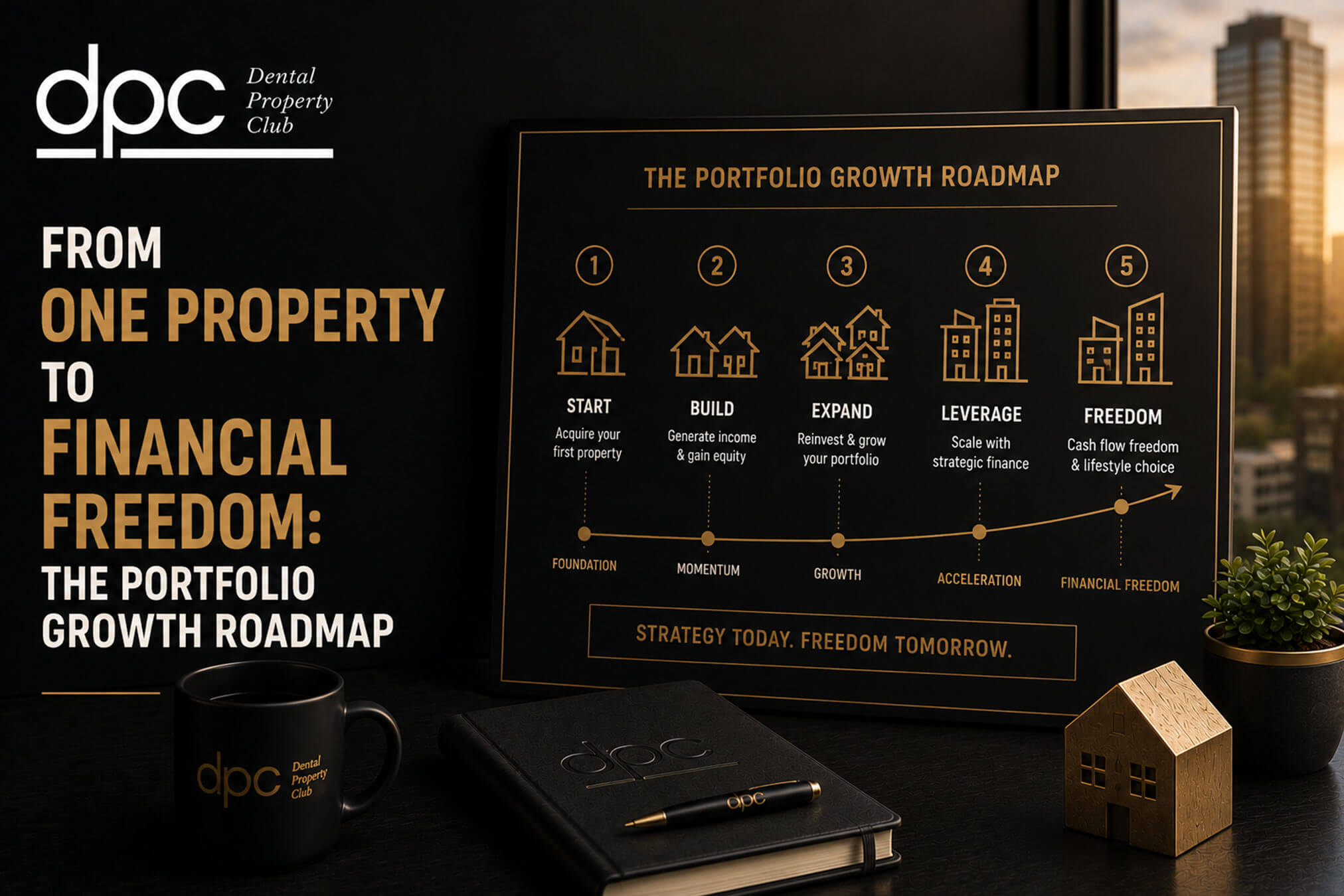
Buying one buy-to-let is a milestone.
It proves you can:
- Save a deposit.
- Get a mortgage.
- Choose a decent area.
- Find a tenant.
- Run the numbers.
But a single property — useful as it is — rarely changes your life on its own.
Financial freedom comes not from one asset, but from a portfolio that works together: multiple properties, each contributing cash flow and capital growth, compounding over time.
This blog outlines a clear roadmap: how a busy dentist can move from one rental property to a serious portfolio in a structured, realistic way.
Stage 1: Make Property 1 Boring and Profitable
Your first property is not just an investment.
It is a prototype.
Before you think about scaling, you need to make sure that this prototype:
- Rents quickly and reliably.
- Generates positive cash flow after all costs.
- Takes minimal mental bandwidth to manage.
That means:
- Confirming your net monthly profit (after mortgage, agent, insurance, maintenance allowance, licences, and an allowance for voids).
- Ensuring you have a contingency fund (3–6 months of costs) so surprises are inconveniences, not crises.
- Using a professional letting agent so the day-to-day doesn’t land in your inbox.
A well-run first property becomes:
- A proof to yourself that the model works.
- A template you can copy.
- A confidence anchor when you buy the second and third.
If Property 1 is chaotic, stressful, or barely breaking even, fix that before you scale.
Stage 2: Set a Clear Freedom Number
You cannot grow a portfolio intelligently if you do not know what you are aiming at.
“Financial freedom” needs to be translated into a monthly number.
Ask:
- What net income (after property costs) would significantly reduce my dependence on clinical work?
- What amount would give me real options — fewer clinical days, more holidays, the ability to say no?
For example:
- If an extra £3,000 per month would transform your life, and
- Each property realistically nets £400–£500 per month after costs,
Somewhere in the region of 6–8 properties over time.
This is not a rigid formula — yields vary, HMOs vs single-lets differ — but it gives you a target.
Without a target, portfolio growth is random.
With a target, you can answer practical questions:
- How many acquisitions do I need?
- Over what time frame?
- At what level of cash flow per property?
This turns property from a hobby into a strategy.
Stage 3: Use Three Growth Levers — Not Just Cash
Most first-time investors think the only way to add properties is to:
- Save another deposit from income.
- Repeat.
This is slow.
Professional portfolio builders use three growth levers:
1 . New savings
- Ongoing allocation from clinical income and other sources.
2. Rental surplus
- Net cash flow from existing properties saved toward new deposits.
3. Equity release (remortgage)
- As properties appreciate and mortgages are paid down, equity builds. You can remortgage to release part of that equity (typically up to 75% loan-to-value) and use it as a deposit for further acquisitions.
Example:
- Property 1 bought at £180,000 with a £45,000 deposit.
- After several years, it's worth £220,000.
- Mortgage still roughly £135,000 (interest-only).
- 75% of £220,000 = £165,000.
- You could potentially release £30,000 (165,000 − 135,000) as equity, keeping the property.
Combine that £30,000 with new savings and rental surplus, and you have most of the deposit for Property 2 without having to save it all from scratch.
This is how one property seeds a second. And as time goes on, two can fund three, three can fund five, and so on.
Stage 4: Systematise Before You Multiply
Most problems that destroy portfolios are not investment problems.
They are systems problems.
Before you grow beyond 2–3 properties, put simple, repeatable systems in place:
- Standard deal analysis template
Same spreadsheet for yield, cash flow, and stress tests on every new property.
- Documented criteria
o Minimum gross yield (e.g. 6%).
o Maximum price range.
o Acceptable locations.
o Property types you will and will not touch.
- Calendar rhythms
o Quarterly review of portfolio performance.
o Annual check-in with broker and accountant.
o Set dates for reviewing rents, insurance, and management.
- Power team relationships
o Broker who knows your growth plan.
o Accountant on top of tax and structure.
o Letting agents who understand your standards.
The goal is simple:
Each new property should slot into an existing machine, not create a new mess.
Stage 5: Decide Your Blend — Single-Lets, HMOs, or Both?
As your portfolio grows, you have a choice:
- Continue with single-lets for simplicity.
- Introduce HMOs or other higher-yield strategies to increase income density.
For many dentists, a sensible progression looks like:
- First 1–2 properties: good single-lets in strong cities.
- Once confident and well-supported: consider one HMO with an experienced HMO agent to boost income.
The aim is to create a balanced portfolio:
- Single-lets: lower hassle, stable tenants.
- HMOs (or similar): higher cash flow per property, managed by specialists.
You do not need 20 properties to change your life.
You might need:
- 3–4 solid single-lets, plus
- 1–2 high-performing HMOs,
…to reach a meaningful freedom number with far fewer front doors than you imagine.
Stage 6: Protect Against Over-Leverage and Fragility
Growth is exciting.
It is also where people get careless.
Over-leverage is one of the most common mistakes when scaling a portfolio: borrowing as much as possible, as fast as possible, with no margin for error.
Safeguards:
- Keep loan-to-value (LTV) around 75% or lower across the portfolio.
- Maintain an emergency fund that covers at least 3–6 months of costs for the entire portfolio.
- Stress test every new deal against:
o Higher interest rates.
o Rent reductions.
o Void periods.
Ask:
“If this property ran 15% worse than expected for a year, would I still be okay?”
If the honest answer is no, think carefully.
The point of your portfolio is to reduce your dependence and stress, not to replace clinical pressure with lender pressure.
Stage 7: Use Milestones, Not Feelings, to Decide When to Slow Down
There comes a point where adding more properties:
- Adds complexity faster than it adds freedom.
You do not need to grow indefinitely.
Decide ahead of time:
- At what monthly net income you will consider slowing acquisitions.
- At what portfolio size (number of properties or total equity) you will focus on optimisation rather than expansion.
For example:
- “When net portfolio income reaches £4,000 per month and total portfolio equity exceeds £500,000, I will slow new purchases and focus on debt reduction or diversification.”
This prevents the “never enough” trap that some investors fall into — endlessly chasing scale without ever enjoying what the portfolio was designed to provide.
Stage 8: Integrate With Your Wider Financial Plan
A property portfolio should not exist in isolation.
For a dentist, it needs to sit alongside:
- Pension (NHS and private)
- Practice or business value
- Other investments
- Personal goals (education, lifestyle, legacy)
At a certain scale, it becomes essential to work with:
- A financial planner familiar with dental professionals.
- A tax adviser who can coordinate company structure, income extraction, and inheritance planning.
Questions to address:
- How will property income and pension interact in retirement?
- Should you gradually de-lever (reduce mortgage debt) as you approach a certain age?
- What is your plan for passing assets to children or other beneficiaries?
Financial freedom is not just “having lots of houses”.
It is having a coherent plan for how those assets support the life you want, at the pace you want, for as
long as you want.
Stage 9: The Real Freedom Is Optionality
The ultimate outcome of a well-built property portfolio is not necessarily:
- To stop clinical work completely (unless you want to).
- To become solely a property investor.
For many dentists, the real win is:
- The ability to choose what type of dentistry they do.
- The freedom to reduce days without fear.
- The option to say no to work that no longer serves them.
- The ability to take actual rest, not just recover enough to go back.
One property is proof of concept.
A portfolio is the infrastructure that supports those choices.
Dr Harry Singh is the founder of the Dental Property Club (dentalpropertyclub.co.uk).
- https://www.youtube.com/watch?v=ECwcTCWTzPE
- https://selectproperty.com/insights/2026-investment-strategies-you-need-to-consider/
- https://tkpg.co.uk/scaling-up-your-property-investment-portfolio-practical-tips-for-success/
- https://www.facebook.com/EastNeukProperties/posts/using-equity-release-to-build-a-property-portfolio-could-leave-you-in-a-position/1006184424858348/
- https://dealsheetai.com/blog/how-to-invest-in-properties
- https://www.ramsayandwhite.com/insights/how-to-start-scale-property-business
- https://sprive.com/blog/understanding-remortgaging-to-release-equity
- https://highfidelityrealty.com/blog/scale-from-one-rental-to-a-portfolio/
- https://www.uswitch.com/mortgages/guides/how-to-release-equity-to-invest-in-property/
- https://www.facebook.com/Propertyinvestmentacademy/posts/you-should-build-a-property-portfolio-in-2026-heres-how-the-uks-leading-property/1324485839828845/
- https://www.linkedin.com/pulse/how-scale-from-one-property-profitable-ex48e
- https://fitchandfitch.co.uk/equity-release-vs-remortgage-are-they-right-for-you/
- https://www.rw-invest.com/uk/how-to-build-a-property-portfolio/
- https://bbmortgages.co.uk/scale-your-buy-to-let-property-business-in-2023-a-guide-for-landlords/
- https://www.aviva.co.uk/retirement/equity-release/

