
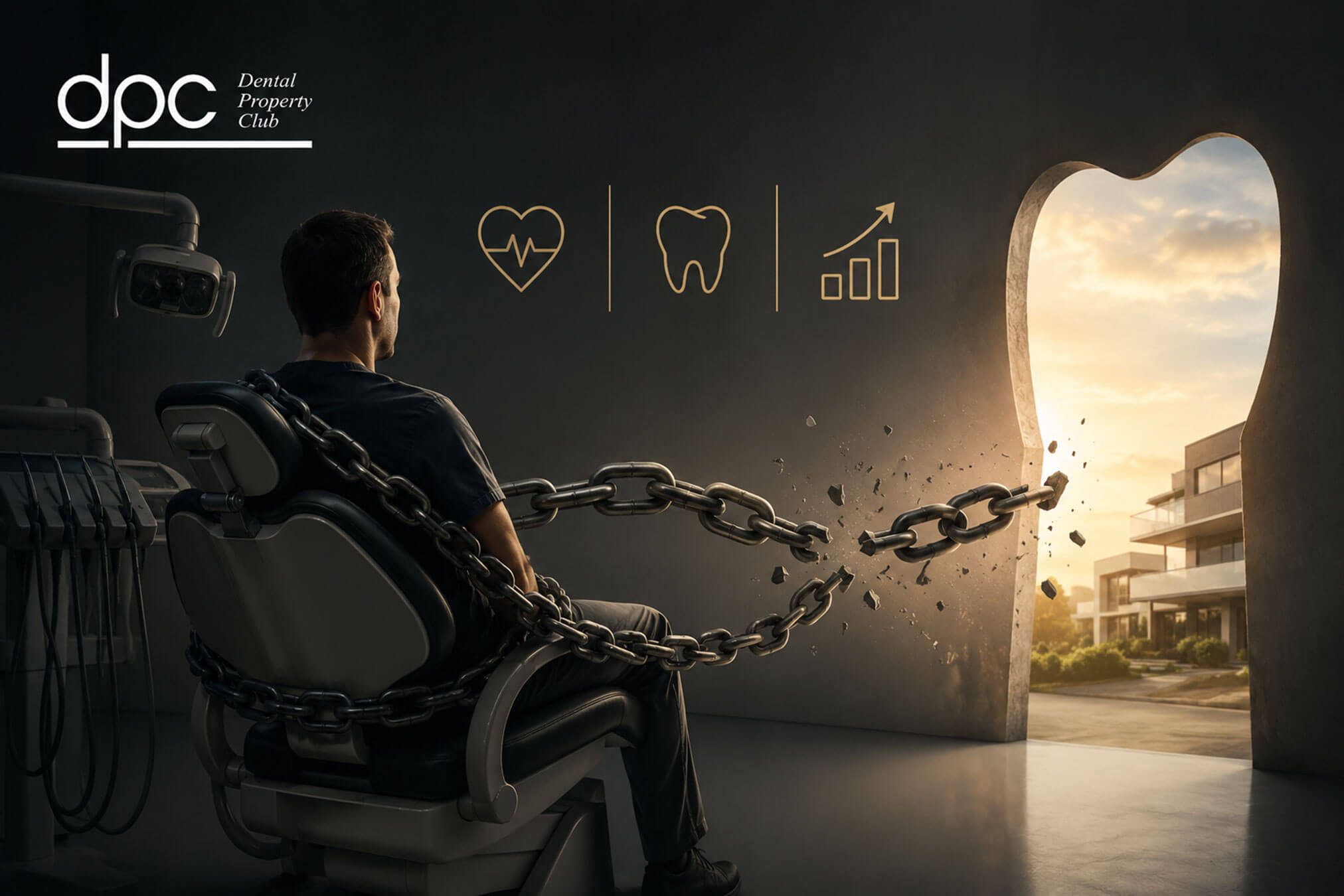
Discover why clinical income dependency is the biggest financial risk facing dentists in 2026 — and how property investing through the Dental Property Club can create lasting financial freedom.
Clinical income dependency occurs when a dental professional’s entire financial security relies on their continued ability to work chairside. It is the primary wealth risk facing UK dentists today. The solution is income diversification through leveraged assets — particularly property — which generates passive returns regardless of clinical capacity. The Dental Property Club has guided dentists toward financial freedom through property since 1998.
Introduction: The Silent Risk Hidden in Every Dental Career
You have done everything right.
You qualified. You trained. You built a patient base. You invested in your skills. By almost every professional measure, you are succeeding.
And yet if your income depends entirely on your ability to be present in surgery — on your hands, your focus, your physical health, and your continued willingness to show up — then everything you have built rests on a single, precarious thread.
That thread is your clinical capacity.
And clinical income dependency — the condition in which your financial security is wholly contingent on that capacity — is the most widespread, most underestimated, and most quietly dangerous financial risk in the dental profession today.
This article explores what clinical income dependency really is, why it affects even high-earning dentists, and why property investment — structured specifically for dental and medical professionals — represents the most practical and proven route to breaking free from it.
By the end, you will understand:
- The structural mechanics of why dentists remain dependent on active clinical income
- The three hidden costs that compound over time inside this model
- Why property is uniquely well-suited to the financial profile of dental professionals
- How the Dental Property Club framework creates passive income in 12 months or less
- The specific first steps to begin building financial independence alongside a clinical career
What Is Clinical Income Dependency?
Defining the Problem
Clinical income dependency is a structural financial condition, not a personal failing.
It describes the situation in which a professional’s income is generated entirely — or almost entirely — through their direct clinical labour. No chair time, no income. No income, no financial stability.
For most UK dentists, this is simply the default model. It is the model dental school prepared them for, the model practices are organised around, and the model most financial advisors default to when they discuss dental professional finances.
It is also deeply fragile.
Why Dentistry Creates Particularly Acute Dependency
The clinical income dependency problem exists in many professions, but dentistry creates a particularly concentrated version of it because of three structural characteristics that rarely receive adequate attention.
The body is the instrument. Clinical dentistry is physically demanding work. Sustained awkward postures, repetitive precision movements, static loading, and constant fine motor control create conditions that accumulate physical wear faster than most professions. Musculoskeletal disorders are the leading cause of ill-health retirement among dental professionals, accounting for 55% of cases, with mean retirement age of just 51.5 years.[cite:web:285] The body that generates clinical income is being degraded
by the process of generating it.
Income is non-residual. Clinical income has one defining characteristic: it stops the moment the clinician stops working. There are no trailing payments, no royalties, no compounding returns. The NHS UDA system has no provision for absence, and private income is equally dependent on presence.[cite:web:280] Every holiday, every illness, every period of reduced capacity produces an immediate and complete income interruption.
The ceiling is structural, not personal. A dentist cannot work more than a certain number of sessions per week. Each session handles a finite number of patients. Each patient generates a finite amount of revenue. No amount of skill, dedication, or ambition can change these arithmetic limits. The income ceiling is not a reflection of individual limitation. It is a structural feature of the model.[cite:web:83]
The Three Hidden Costs of Clinical Income Dependency
Understanding clinical income dependency fully requires looking beyond the obvious financial exposure and examining three compounding costs that most dental professionals never properly quantify.
Hidden Cost 1: The Physical Depletion Price
Every clinical session produces work. But it also produces wear.
The research on occupational health in dentistry is consistent and sobering. Musculoskeletal disorders affect 61% of dental professionals — the highest rate of any clinical profession.[cite:web:277] Back pain, neck disorders, shoulder pathology, and repetitive strain conditions are not occasional inconveniences.
They are occupational norms.
The hidden financial cost of this physical depletion is significant. A dentist who develops a debilitating shoulder condition at 48 does not simply suffer physically. They face:
- An immediate and complete loss of clinical income
- A potential permanent reduction in earning capacity
- No fallback income from non-clinical sources if none has been built
- A financial exposure that income protection insurance, at 60-70% of gross earnings, does not fully resolve[cite:web:277]
The physical depletion price is paid slowly, invisibly, and entirely in advance — often before the clinician has built any financial structure that would survive its collection.
Hidden Cost 2: The Compounding Opportunity Cost
Time is the primary input of clinical income dependency. But time is also the primary input of wealth- building.
A dental professional running at full clinical capacity — using all available time to maximise active income — is simultaneously consuming the resource required to build the assets that would free them from that capacity.
This is the compounding opportunity cost.
It operates like compound interest in reverse. Every year spent fully inside the active income model is a year in which:
- Property values have continued to rise without the benefit of the dentist's participation
- Rental yields have been collected by someone else
- The asset base that would generate passive income has not been growing
- The equity available for leverage has been dormant
The dentist who begins building a property portfolio at 35 and the dentist who begins at 48 are not simply 13 years apart in calendar time. They are separated by the entire compounding effect of 13 years of asset appreciation, rental income, and equity growth.[cite:web:262]
Opportunity cost is invisible because it is the cost of what is not built. But invisibility does not mean insignificance. Over a career, the gap between the dentist who started diversifying early and the one who waited can be measured in millions.
Hidden Cost 3: The Psychological Tax
The third hidden cost of clinical income dependency is not financial. It is psychological.
When financial security is entirely contingent on continued clinical capacity, work changes character. It stops being an expression of professional identity and vocational purpose. It becomes a financial necessity — one from which the practitioner cannot afford to step back, slow down, or disengage, regardless of how they feel.
This is what transforms clinical work from something meaningful into something compelled. And compelled work produces a specific kind of mental load: the awareness, often half-conscious but always present, that everything depends on the next session, the next week, the next month.
Research links this sense of financial entrapment directly to the burnout profile that makes UK dentistry one of the highest-risk professions for mental health deterioration.[cite:web:261] The psychological tax of dependency accumulates alongside the physical one — and the two compound each other in ways that no income protection policy can adequately address.
Why Property Is the Natural Antidote for Dental Professionals
The Case for Property Specifically
There are many ways to diversify income. Equities, bonds, business investments, and alternative assets all have legitimate roles in a well-constructed financial plan. But for dental professionals specifically, property investment offers a combination of characteristics that no other asset class reliably replicates.
It uses professional strength as leverage. The dental professional has something that property investment rewards directly: a stable, demonstrably high income and strong creditworthiness. Lenders view professional borrowers favourably. This means the dentist who has been building clinical income for five or ten years has already accumulated the key ingredient that property investment requires: the financial credibility to access leverage.[cite:web:279]
It generates genuinely passive returns. Rental income from a well-managed property portfolio does not require clinical presence. It does not require professional qualifications. It does not require physical health. It arrives regardless of whether the owning dentist is in surgery, on holiday, or recovering from injury.[cite:web:274] This is the structural break from active income dependency that no amount of clinical earnings can replicate.
It appreciates over time. UK property has a long-term appreciation record that, particularly in strong rental markets, compounds meaningfully over decades.[cite:web:11] The dentist who acquires a property today is not merely buying today’s yield. They are capturing the full trajectory of that asset’s appreciation over the remainder of their professional life.
It is manageable alongside a clinical career. Unlike many business ventures, a properly structured property portfolio does not demand the same kind of full-time operational attention that a second business would require. Dr Harry Singh’s own Dental Property Club model delivers results in just 7-10 hours per week — a commitment that sits comfortably alongside a full clinical schedule [cite:web:268]
Why the Dental Profile Is Ideally Suited
The dental professional approaching property investment does not come empty-handed.
They come with:
- A high and stable income that supports strong borrowing capacity
- Professional credibility that improves lender relationships
- Analytical and precision skills that transfer well to property due diligence
- A career model that, while demanding, typically leaves some time outside surgery hours for strategic activity
- A strong motivation to build financial security that does not depend on continued clinical capacity
This combination — high income, stable profile, leverageable credibility, and strong motivation — is exactly the profile that property investment rewards most consistently.[cite:web:266]
The Dental Property Club Framework: From Clinical Dependency to Financial Independence
A System Built by a Dentist, for Dentists
The Dental Property Club was founded by Dr Harry Singh — a practising dentist who built a £7 million property portfolio and a six-figure annual passive income over a 22-year investing journey that began in 1998.[cite:web:268]
That background matters.
The framework Dr Singh has developed is not generic financial advice adapted for healthcare professionals. It is a system built from the lived experience of navigating the specific tensions, time constraints, financial profiles, and professional pressures that define dental careers.
The twelve proven methods at the core of the DPC approach are designed to work within the constraints of a full clinical practice — not in spite of them.
The Core Principles of the DPC Approach
Yield above 6%. The Dental Property Club focuses on investments that produce meaningful cash flow from the outset. Dr Singh specifically recommends targeting yield above 6% — annual rent as a proportion of market value — to ensure that the investment generates positive income rather than simply speculative appreciation.[cite:web:11]
Leverage as the primary wealth mechanism. Buying outright from savings is not the only way to acquire property. The DPC framework specifically teaches how to use mortgage finance — other people’s money — to control larger assets than direct capital would allow. A dentist with a £75,000 deposit can control a £300,000 asset and receive returns calculated on the full asset value, not just the deposited capital.
Buy-to-let within a limited company structure. The 2026 regulatory and tax environment increasingly favours property investment held within a limited company structure, particularly for higher-rate taxpayers.[cite:web:287] The DPC framework incorporates current tax strategy, not generic advice applicable to a previous era.
Joint venture opportunities. For dentists who want to participate in property investment but have limited time for direct acquisition, Dr Singh offers structured joint venture arrangements — allowing passive co-investment in deals he is actively managing.[cite:web:268]
Location intelligence. The UK’s fastest-growing buy-to-let markets in 2026 include Manchester (8.6% new policy growth), Liverpool (8.3%), Leicester (8.0%), Leeds and Birmingham (both 7.9%).[cite:web:281] The DPC framework includes specific location strategy tuned to current market conditions.
What Results Look Like
The Dental Property Club framework is designed to deliver meaningful passive income within 12 months of beginning serious implementation.
Testimonials from DPC members consistently describe:
- Securing their first property deals using strategies taught at the advanced workshop
- Saving hundreds of pounds per month on existing mortgage arrangements through the DPC power team
- Building portfolios that generate income independent of clinical activity within the first year
Dr Singh’s personal journey from his first property in 1998 to a £7 million portfolio and six-figure passive income represents the long-term compounding potential of the approach — but the short-term results are
also real, accessible, and frequently achieved by dental professionals with no prior investment experience.[cite:web:268]
Breaking Clinical Income Dependency: A Strategic Framework
Understanding the problem and the solution is necessary. But clarity without a pathway remains conceptual. The following framework translates the principles above into a practical sequence.
Stage 1: Diagnose the Dependency
The first step is an honest audit of current financial architecture.
Ask:
- What percentage of your household income is generated by clinical activity?
- What happens to that income if you are unable to work for 3 months? 6 months? Permanently?
- Do you have appreciating assets generating income independent of your clinical presence?
- Is your current financial trajectory genuinely moving toward independence, or simply sustaining current obligations?
For most dental professionals, this audit reveals a clinical income dependency ratio of 90-100% — meaning nearly all financial security is contingent on continued clinical capacity.
Stage 2: Establish the Financial Platform
Before acquiring property, the financial platform needs to be optimised:
- Understand your borrowing capacity. A dental professional with a strong NHS or private income is in a significantly more favourable borrowing position than they typically realise. Specialist dental and medical mortgage brokers can provide an accurate picture.
- Separate personal and investment finances. Setting up the appropriate corporate or holding structure before acquisition protects against the personal tax inefficiencies that catch many first- time investor dentists.
- Create the deposit pool. This may come from savings, equity release on an existing property, or family resources. The DPC framework works with realistic deposit sizes and does not require a large initial capital outlay.
Stage 3: Acquire the First Asset
The first property acquisition is structurally significant beyond its financial return.
It represents the moment clinical income dependency is first interrupted. The moment when income begins to exist in a form that does not require physical presence. The moment when the trajectory of financial life changes.
DPC’s workshop programme specifically guides practitioners through the acquisition process — including property selection, negotiation, finance, legal structure, and lettings management — to make this first step as frictionless as possible.[cite:web:270]
Stage 4: Systematise and Scale
Once the first property is generating yield, the model can be replicated.
Rental income from the first property services mortgage payments and creates surplus. That surplus, combined with continued clinical income, accelerates the deposit pool for the second acquisition. The second acquisition generates additional yield. The compounding begins.
The dentist who acquires one property per year for five years has built a portfolio that, by year ten, is generating passive income that materially reduces their dependence on clinical presence.
Stage 5: Recalibrate Professional Life
This is the stage that most property investment frameworks forget to include — but it is often the most meaningful.
When passive income reaches a meaningful level, clinical work changes character.
Not because dentistry stops mattering. But because it stops being financially compelled.
The dentist who chooses to treat patients from a position of financial strength experiences work differently from one whose entire security depends on showing up regardless of how they feel.
This recalibration — from clinical necessity to clinical choice — is the experience of freedom that drives every serious Dental Property Club member’s journey.
Frequently Asked Questions
How much money do I need to start investing in property as a dentist?
The entry point varies by market and strategy, but the DPC framework is designed to work with realistic deposit sizes available to established dental professionals. The more important question is borrowing capacity — which, for a dentist with stable income, is typically stronger than they realise. Dr Singh recommends a consultation before assuming the amount you have is insufficient.
How much time does property investing require alongside a clinical practice?
The DPC model is specifically designed for busy clinicians. Dr Singh manages his own portfolio — which generates six-figure annual passive income — in 7-10 hours per week.[cite:web:268] The workshop programme teaches time-efficient strategies including professional letting management, power team relationships, and deal analysis frameworks that do not require the practitioner to become a full-time landlord.
Is property still a good investment in the UK in 2026?
UK buy-to-let markets are showing strong recovery and growth in 2026. Manchester leads with 8.6% growth in new landlord policies, followed by Liverpool at 8.3% and Leicester at 8.0% [cite:web:281] Rental demand remains structurally strong across major cities. The Renters’ Rights Act (effective May 2026) creates additional considerations for traditional buy-to-let but also opens opportunities in more regulated sectors such as purpose-built student accommodation and specialist supported housing.[cite:web:284]
What tax structure should I use for property investment as a dentist?
Higher-rate taxpayers — which most established dental professionals are — benefit significantly from holding property within a limited company structure, particularly in 2026 as Making Tax Digital requirements take effect.[cite:web:287] The DPC framework addresses tax strategy specifically for dental professionals, including the interaction between clinical income, property income, and pension contributions.
What is the Dental Property Club and how do I join?
The Dental Property Club is the property investment platform founded by Dr Harry Singh, designed specifically for dental and medical professionals. It offers workshops (including a 3-day Advanced Property Workshop), joint venture opportunities, community membership, and ongoing support post-
workshop. The starting point is a free report — 10 Secrets to Successful Property Investing for Busy Dentists — available at dentalpropertyclub.co.uk.[cite:web:270]
The Strategic Imperative
The dental profession in 2026 is operating in a period of accelerating change. NHS contract reforms, rising costs, growing regulatory complexity, and an increasingly demanding clinical environment are placing unprecedented pressure on the active income model that most dental careers are built on.[cite:web:275]
In this context, clinical income dependency is not simply a personal risk. It is a professional vulnerability — one that grows more acute with every year it is allowed to persist unchallenged.
The dentists who will experience genuine professional freedom in the years ahead are not necessarily those who earn the most from the chair. They are those who understood earliest that clinical excellence and financial freedom are not the same thing — and who began building the structure that bridges the two.
Property investment, guided by a framework built specifically for dental professionals, is that bridge.
It does not ask clinicians to abandon dentistry. It asks them to build something alongside it — something that keeps working when the surgery is closed, when the body is resting, and when the appointment book is finally, freely, a choice rather than a necessity.
That is the promise of the Dental Property Club.
And it is available to any dental professional willing to take the first step.
Begin your property journey: Visit dentalpropertyclub.co.uk to, explore the workshop programme, or speak directly with Dr Harry Singh about joint venture opportunities.

